
Commercial Flat Roofing in Northern Virginia: A Business Owner’s Guide
Your commercial roof is a business asset — and when it fails, the cost isn’t just repairs, it’s downtime, damaged inventory, and disrupted operations. Here’s what NoVA property owners and managers need to know about flat roofing systems, drainage, and knowing when to act.
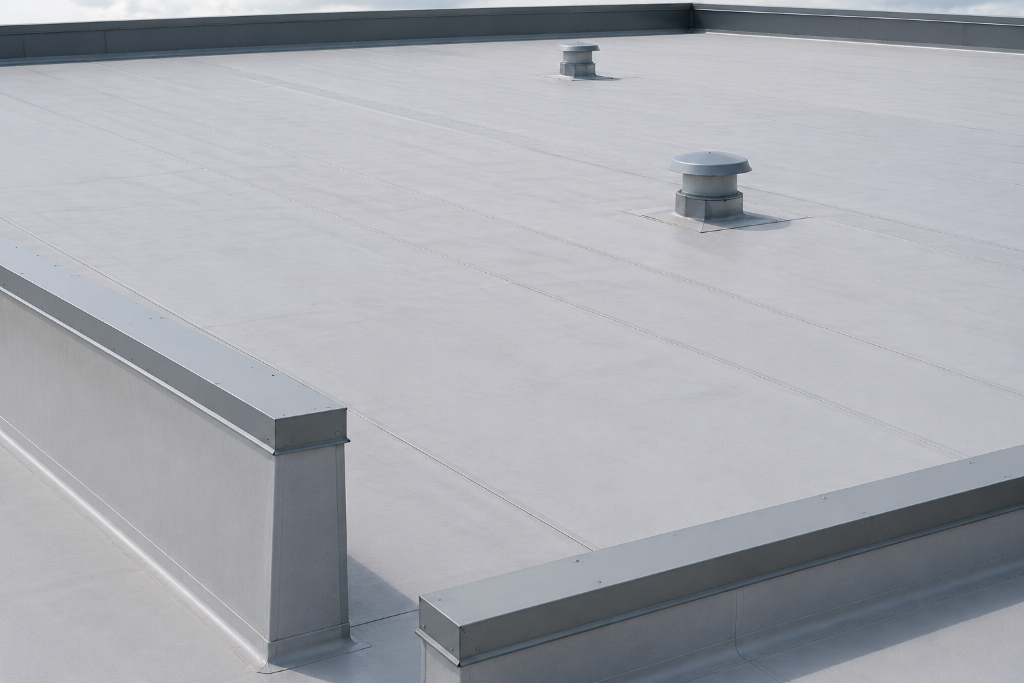
Quick Answer for Business Owners
- Most commercial roofs are low-slope, not truly flat — and use membrane systems like TPO, EPDM, or modified bitumen rather than shingles.
- Water is the enemy. Standing (“ponding”) water that lingers more than ~48 hours after rain is a warning sign, not a cosmetic issue.
- Most failures start at seams, flashing, and drains — the details, not the field of the roof.
- You often have more options than “repair or replace.” Restoration and recoating can extend a sound roof’s life and defer a full tear-off.
- Speed protects your bottom line. On a commercial building, a small leak can mean closed doors, ruined stock, and lost revenue — so response time matters more than on a home.
- Start with a professional inspection — Sam Construction Group offers free commercial roof inspections across NoVA at (571) 373-6388.
A commercial roof rarely announces its problems politely. It works silently for years, then a seam lets go during a storm, water finds the one low spot that never drains, and suddenly you’re mopping a sales floor or relocating inventory. For Northern Virginia businesses — from Fairfax retail strips to Tysons-area offices and warehouses along the county’s commercial corridors — the roof is one of the most valuable and most overlooked assets on the property. This guide covers what you actually need to know to protect it.
What are the most common commercial flat roofing systems?
“Flat” roofs are almost always slightly sloped to drain. What varies is the membrane covering them:
| System | What it is | Strengths |
|---|---|---|
| TPO (thermoplastic) | Single-ply white membrane, heat-welded seams | Reflective/energy-efficient, strong seams, popular on newer buildings |
| EPDM (rubber) | Single-ply synthetic rubber membrane | Durable, weather-resistant, long track record |
| Modified bitumen | Asphalt-based membrane in reinforced layers | Tough, good for foot traffic, multi-ply protection |
| Built-up (BUR) | Multiple layers of asphalt & felt (“tar and gravel”) | Redundant layers, proven longevity on older buildings |
The right system depends on your building, budget, energy goals, and how much rooftop foot traffic (HVAC service, etc.) it sees. There’s no single “best” — there’s the best fit for your property, which is exactly what an inspection and honest assessment should determine.
Why is standing water a problem on a flat roof?
On a sloped residential roof, water sheds fast. On a low-slope commercial roof, drainage is engineered and fragile — a clogged drain, a sagging deck, or a settled low spot can leave water sitting for days. That standing water does real damage:
- Accelerates aging of the membrane through constant saturation and UV-plus-water exposure
- Adds weight — water is heavy, and ponding stresses the roof structure over time
- Finds seams and penetrations, turning a minor imperfection into an active leak
- Breeds vegetation and debris buildup that clogs drainage further — a worsening cycle
⚠️ The 48-hour rule
If water is still standing on your commercial roof more than two days after it stops raining, that’s not normal weathering — it’s a drainage problem worth inspecting. Ponding is one of the most common precursors to commercial roof failure, and it’s fixable when caught early.
How do I know if my commercial roof needs repair, recoating, or replacement?
Commercial roofing gives you a middle option that residential shingle roofs generally don’t — restoration. Here’s the spectrum:
| Option | Best when… | What it does |
|---|---|---|
| Repair | Damage is isolated (a seam, a puncture, flashing) | Fixes the specific problem; most cost-effective for localized issues |
| Restoration / recoating | Membrane is aged but fundamentally sound and dry | Applies a new protective coating to extend service life and defer replacement |
| Replacement | Widespread failure, trapped moisture, or deck damage | New roof system; the right long-term move once a roof is truly done |
Knowing which category your roof falls into requires a professional assessment — often including moisture detection to find saturation you can’t see from the surface. A reputable contractor will tell you when a restoration will buy you years, and equally, when it’s just delaying an inevitable replacement.
“On commercial roofs, the cheapest option in the moment isn’t always the smartest one. Sometimes a coating buys you five more years for a fraction of a replacement — and sometimes a coating over a wet roof just traps the problem. The only way to know is to look properly.”
— Sam Construction Group, commercial roofing team
Water pooling on your building’s roof?
A free commercial roof inspection identifies drainage issues, seam failures, and hidden moisture before they close your doors.
What causes most commercial roof failures in Northern Virginia?
The leading culprits behind commercial roof leaks in our region:
- Seam and flashing failures. The joints and the transitions around edges, curbs, and penetrations are where membranes most often separate and leak.
- Poor drainage & ponding. Clogged or undersized drains leave standing water that breaks the roof down over time.
- Storm damage. Wind can lift or tear membrane edges, and hail can bruise and puncture — and wind/hail is the #1 cause of insured property damage nationally, per the Insurance Information Institute.
- Foot traffic & rooftop equipment. HVAC service crews and equipment vibration wear membranes at high-traffic spots and around units.
- Thermal cycling. NoVA’s hot summers and freezing winters expand and contract materials repeatedly, fatiguing seams and fasteners.
- Deferred maintenance. Small, cheap-to-fix issues left unaddressed become large, expensive failures.
Why does fast response matter more on a commercial roof?
When a home springs a leak, it’s disruptive. When a business does, it can be existential for that day’s operations: a flooded retail floor sends customers away, water over server equipment or machinery halts work, ruined stock is money gone, and a closed storefront is revenue that doesn’t come back. That’s why commercial roofing rewards prevention and speed far more than residential.
The smartest NoVA property owners treat their roof as a managed asset: regular inspections (especially after major storms), prompt repair of small issues, drainage kept clear, and documented records that also help with warranty and insurance. A proactive maintenance relationship almost always costs less than emergency replacement and downtime.
How do I choose a commercial roofing contractor in Northern Virginia?
Commercial roofing is not just residential roofing at a bigger scale — the systems, drainage, and stakes are different. When vetting a contractor, confirm they:
- Are licensed and insured in Virginia and will show proof
- Have real experience with your membrane type (TPO, EPDM, modified bitumen, BUR)
- Offer thorough inspection and honest options — repair, restoration, and replacement, not just the biggest job
- Are local and responsive, so downtime is minimized and warranty support is real
- Can document damage for insurance when storms are involved
Frequently asked questions about commercial flat roofing
How long does a commercial flat roof last?
It depends on the system, installation quality, drainage, and maintenance. Single-ply membranes like TPO and EPDM and multi-ply systems like modified bitumen and BUR each have different service lives, and good maintenance can meaningfully extend any of them. An inspection gives you a realistic read on where your specific roof stands.
Can a commercial roof be restored instead of replaced?
Often, yes — if the membrane is aged but still sound and dry, a restoration coating can extend its service life and defer a full replacement. If moisture is already trapped in the system or the deck is compromised, replacement is usually the better long-term choice. Moisture testing during inspection determines which applies.
Do you handle storm-damage insurance claims for commercial buildings?
Yes. Sam Construction Group inspects and documents commercial storm damage and supports you through the insurance-claims process. Commercial claims can be more complex than residential, so thorough documentation and timely reporting are especially important.
How often should a commercial roof be inspected?
A good rule of thumb is at least twice a year plus after any major storm, along with keeping drains and gutters clear. Regular inspections catch small seam, flashing, and drainage issues while they are inexpensive to fix — well before they become leaks and downtime.
Do you offer free commercial roof inspections in NoVA?
Yes. Sam Construction Group provides free, no-obligation commercial roof inspections across Fairfax and Northern Virginia. Call (571) 373-6388 to schedule.
Protect Your Building — Start with a Free Inspection
From ponding water and seam repairs to full membrane replacement and storm-damage claims, Sam Construction Group keeps Northern Virginia businesses covered. Get an honest assessment of your commercial roof today.
☎ (571) 373-6388This article is general information for Northern Virginia commercial property owners and is not a substitute for a professional roof inspection. Roofing system performance varies with installation, drainage, and maintenance. Drainage/ponding guidance per National Roofing Contractors Association (NRCA) standards; storm and insurance statistics per Interactive Hail Maps and the Insurance Information Institute (Triple-I).